
On Keeping a Record
A discussion of the intrinsic/extrinsic value of tracking what we read

I recently finished reading John Steinbeck’s East of Eden. For those of you who don’t know, this book clocks in at a cool 600 pages (with small print). In other words, finishing this was no mean feat, the literary equivalent of a twenty mile hike (or maybe more). Hell, even starting it was intimidating (imagine the hike goes straight uphill - am I losing you on the metaphor?).
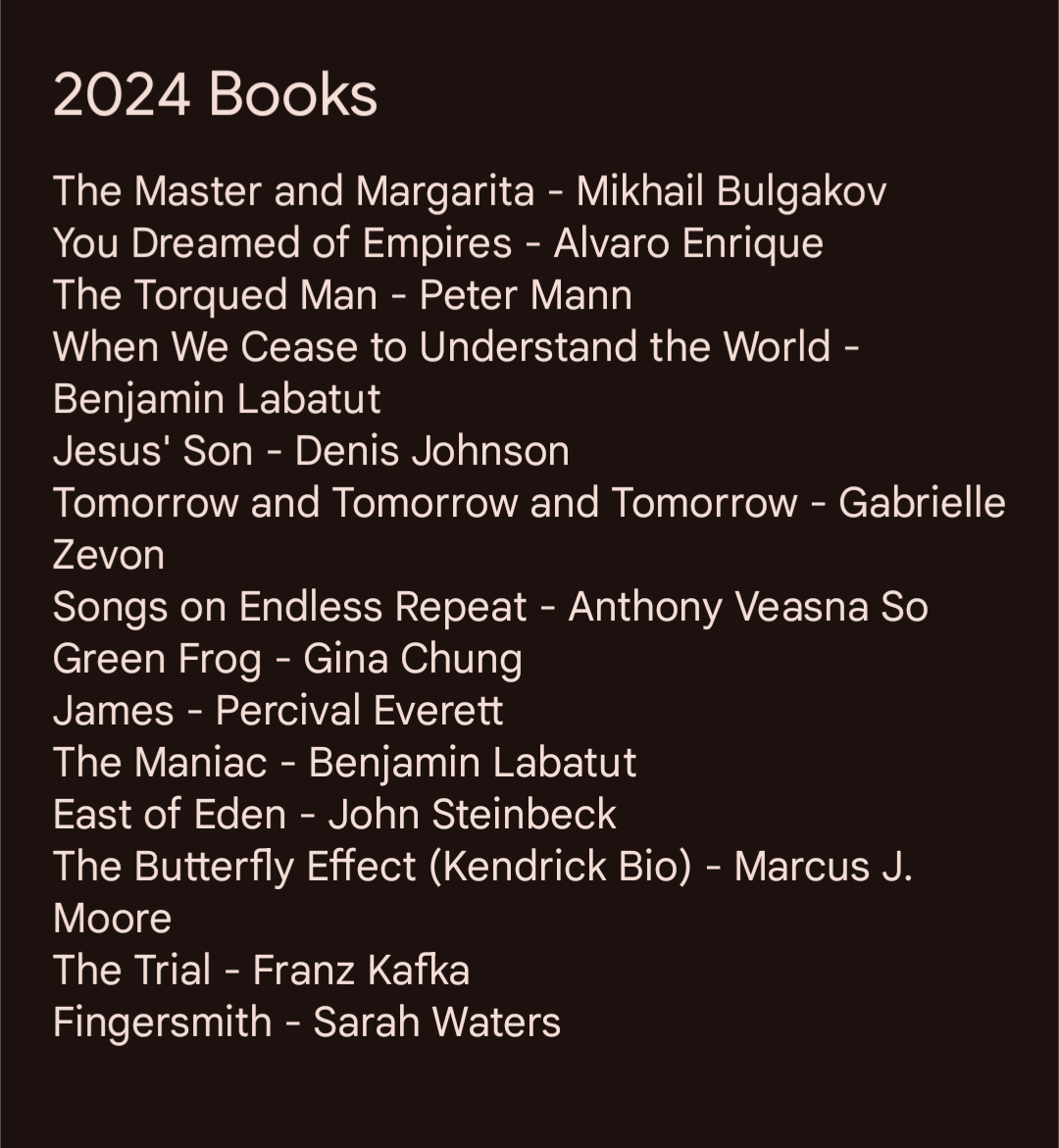
But you know what was damn satisfying? Writing out the words, East of Eden - John Steinbeck - on my 2024 Book List.
Now to be clear, I don’t just read books so I can say I’ve read them or so I can add them to a list. My motivation is, I’d like to think, more complex and varied than that.1 Still, I can’t pretend like it didn’t feel good, like I didn’t notice the dopamine hit, the swell of pride at adding one of literature’s most lauded tomes to my personal record.
I’ve been keeping track of the books I read since 2017, and I wish I’d started sooner. I don’t remember exactly why I began, other than that it seemed like a good idea and that - at that moment - I was having trouble recalling every thing I’d read up to that point. Sure, there were some books I knew I’d never forget - The Sound and the Fury, On the Road, The Catcher in the Rye - but there were others that were falling through the cracks of my memory. We all think we can remember the books we read - and when someone brings one up, we can often say with certainty, “yes, I’ve read that!” - but I challenge you to recall each and every book from five years prior, from last year, from last month even.
So why does it matter?
Well, for one, I don’t discount the importance of intrinsic value - in this and in life. The whole idea that intrinsic value has lost its intrinsic value is something I’ll explore in another post, but for now, let’s just acknowledge the internal benefit of finishing a book. To finish a book is to learn something new about the world. It is to become cultured, educated, worldly. Or perhaps it is just to have enjoyed life for a spell, to have bit into a thick, juicy plot, to have reveled in the mystery and titillation. The completion of a book means different things to different people, but no matter what each completion means, to record that finishing is to recognize some undefinable, priceless joy.
That’s not to say that there isn’t some extrinsic value as well. As I plan for my AP Literature class, I am often trying to update and revise my curriculum. More than once I have been trying to think of some new book to include that might satisfy some standard or fill some gap in the learning. And in these moments, where better to look than my trusty, annualized lists? And to further exemplify, my coworker organized an independent reading project for his students and asked me for five book recommendations. While I could think of a few off the top of my head, it was returning to my lists reminded me of reading This is How You Lose the Time War, a uniquely constructed epistolary sci-fi novel by Amal El-Mohtar and Max Gladstone in which the dual-protagonists’ (and antagonists (at first)) letters are penned by the two authors as an organic, unscripted back-and-forth.
And moreover, as previously discussed, most of our memories aren’t so hermetic that we remember every single piece of art we’ve consumed (imagine trying to list all the movies you’ve ever seen). Such is nature of records writ large: to write something down entrenches a moment into memory, makes the ephemeral permanent. There is also an associative nature to reading, and a reading record can benefit - and benefit from - this. Two summers ago, I went on a wonderful trip to the Asain/Asian-American diaspora. In a row I read Anthony Veasna So’s Afterparties, Viet Thahn Nguyen’s The Sympathizer and Qiu Miaojin’s Notes of a Crocodile. Recently, I telling a friend about this “trip,” extolling the excellence of these works. I remembered the first two books, but just couldn’t place the third. Good thing I’d written it down.
If you’re a reader, though you may remember the details of a book years later - the plot, characters, etc., - what you may forget is the time and place of the reading experience. Don’t discount the reading experience. Don’t discount the time and place and feeling that accompanies losing yourself in a good book. Sure, there will be plenty of books that get lost in the shuffle, but there will be times when the experience carries some greater weight. To keep a record of what you read allows you to return to these moments, to embrace the nostalgia of concentrated moment in time, a peaceful place, a cathartic feeling. When, for example, I look back at my list from three years ago and see Love in the Time of Cholera, I remember the warmth of that spring, the late light, the ease of those evenings. When I see A Farewell to Arms, I remember the hammock laid in and the lake I hung by. Geek Love reminds me of my time living in Hawaii, the strange yet satisfying dissonance between Honolulu’s Edenic setting and the dystopian, carnivalistic anarchy of the novel.
So, why keep a record? Because just seeing the name of a novel on a list can serve as a personal time machine. It can help us remember, can help us reflect. And, maybe, upon reflecting, we realize sometimes about who we were at that time. Or maybe we write it down because, well, why the hell not?
Thanks for reading. Until next time…
You can read about these motivations in my “Why I Read” post
Agreed - I find soany good books just by exploring. But that's the benefit of their being so much great literature - in any genre, there are great books to read.
Reading is a key element in lifelong learning.
I confess that most of what I read these days is in the genres that I write. But when I was still teaching, I was constantly lookin for new titles, just as you are. That was particularly true for my World Lit class, for which I read all kinds of authors I had never even heard of prior to searching.